

Welcome to the latest update on the Whitesands Project.
The Flood Protection Scheme Update
The final design and project costs for the Whitesands Flood Protection Scheme – together with plans for public realm improvements – are still to be presented to Full Council for approval.
In this issue we will bring you up-to-date, on the progress of the scheme including news on our environmental surveys, a roundup of recent discussions with key stakeholders, and a review of our public engagement sessions held in September 2025.
McLaughlin & Harvey Awarded ECI Contract
UK-based civil engineering firm McLaughlin & Harvey was awarded the ECI contract for the Whitesands Flood Protection Scheme through an open tender process.
An ECI contract usually involves two stages – in stage one, a contractor is engaged early to provide pre-construction services such as planning and costing works, and stage two involves carrying out the actual construction works.
The first phase focusses on McLaughlin & Harvey working with the council to refine the scheme’s design, phasing, and project costs. This will help ensure the project is buildable, cost-effective and minimises disruption before any major construction begins.
If approved, phase two would deliver the flood defences themselves – including new flood walls, glass panels, gates and a raised riverside walkway.
The proposed funding model is 80% from the Scottish Government and 20% from the council, subject to approval.
No commitment to the full expenditure will be made unless councillors agree to advance the scheme at Full Council.
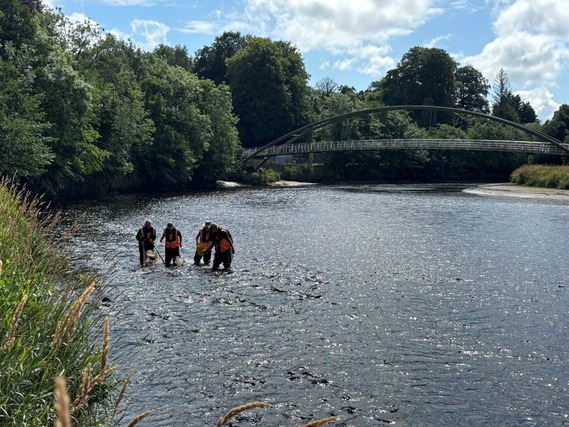 |
Nith Catchment Fishery Trust in the River Nith undertaking aquatic surveys
Findings are in for Environmental Surveys Carried Out During Spring and Summer
In the last newsletter we spoke about plans for a series of ecological and wildlife surveys to better understand the unique river environment along the Whitesands. The project footprint lies at the heart of the Dumfries Conservation Area, so it is vital that we are sensitive to the historic character of the town while also protecting the ecology of the River Nith and the species it supports.
Between April and August 2025, a wide range of surveys were carried out looking at bats, birds, otters, fish and aquatic invertebrates. These studies provide an essential baseline helping the project team design flood defences that protect both people and wildlife.
What We Found Out
Several bat species were identified, including Daubenton’s, common pipistrelle and soprano pipistrelle. Specialist dusk emergence and tree-climbing surveys were conducted to identify any roosts that could be affected. Our next hibernation surveys will take place during the colder winter months.
Kingfishers were spotted passing through the survey area, although no suitable nesting habitat was found along the riverbanks. Nith Catchment Fishery Trust were commissioned by the project team to undertake a number of surveys within the aquatic environment of the River Nith including otter and water vole surveys. While these confirmed that otters regular use of the river throughout the reach, there was no evidence of water voles detected.
Surveys carried out in the River Nith are crucial in establishing baseline information on the types and numbers of species present within the area adjacent to the planned flood protection scheme. Within the River Nith itself, surveys recorded a healthy range of fish species, including juvenile Atlantic salmon, trout, grayling, minnow, stoneloach, stickleback, flounder, European eel and lamprey – many of which are protected. Aquatic invertebrates were also sampled to provide insight into overall water quality, and results are now being analysed.
The surveys also highlighted the presence of several invasive species, including American signal crayfish, Himalayan balsam, giant hogweed, American skunk cabbage and Japanese knotweed. Careful biosecurity planning will be essential to ensure construction does not contribute to their spread.
Findings from the surveys enable the project team to ensure appropriate measures can be incorporated into the project as it develops to assure the protection of these species throughout the construction phase.
 |
Shaping the Future of Whitesands Together
The Whitesands Flood Protection Scheme is a major investment in the future of Dumfries. But it’s not just about protecting the town from flooding – it’s about creating a vibrant, welcoming riverside space that everyone can enjoy.
This rare opportunity to access 80% Scottish Government funding means we have a unique opportunity to transform the River Nith waterfront into a lively, inclusive place where people can relax, explore, and connect with nature and each other.
How the local community has helped us with this design phase
Our design team at Jacobs has completed the first stage of the design, focusing on where the flood defences will go. Over the summer, we’ve been working on the next phase – designing the look and feel of the riverside, including landscaping and green spaces, pathways and lighting, seating and play areas. To make sure these spaces work for the people who use them every day, we’ve been asking for your input.
On 2 and 3 September, the project team hosted public engagement sessions in the Standard Building, High Street, Dumfries focused on Greensands, Upper Whitesands and Dock Park, to help us understand how people use the riverside now, what they value most, and what would make them want to spend more time there.
Over 160 people attended across the two days, taking the opportunity to view the latest project plans speak directly with the project team – including representatives from Dumfries and Galloway Council, Turner & Townsend and Jacobs – and share their ideas for the future of the riverside.
The events generated valuable feedback, which, alongside responses to a public survey, will play a key role in shaping the final design. A summary report of the feedback can be found here.
In addition, we continue to engage and gather feedback from our key stakeholders. This feedback will help us design spaces that are flexible, inclusive and futureproof – ensuring that the new Whitesands works for everyone, now and for generations to come.
Did You Know?
Some people think that the flood protection scheme will make flooding worse in other places.
The flood protection scheme has been carefully designed so it doesn’t make flooding worse upstream or downstream. Our consultants use specialised computer modelling to understand how the river behaves before and after the scheme is built. These models have assisted in the final design of the scheme.
One of the most important parts of designing a flood scheme is making sure it doesn’t cause problems elsewhere.
Next Steps
A Full Business Case – including final design details and project costs will be presented to Full Council.
Get in Touch
If you have any questions, please contact the project team on WhitesandsProject@dumgal.gov.uk.