

Forum Replies Created
-
AuthorPosts
-
John Shields
KeymasterFrom Michael Ansell – 27 Jun 2020…
Very much agree Alan, the other complication being the apparent ease with which pronunciations fluctuate between ‘Mini’ and ‘Moni’ as in Moniaive – to this day.
Kind Regards
Michael
KeymasterFrom Alan James – 27 Jun 2020
Thanks Michael
I agree the possibility of monadh-buidh should be acknowledged, though monadh itself being pretty surely from mönïδ, a pre-existing Brittonic name can’t be ruled out. But, while it’s often difficult or impossible to distinguish ‘Mony’ a mönïδ from monadh, forms with Min-, and especially Minni-, don’t in general seem to me to have definitely Gaelic specifics, I think they’re more likely to reflect the Brittonic variant mïnïδ. But without much more and earlier documentation, the health warning is certainly necessary
KeymasterFrom David Devereux – 29 Jun 2020…
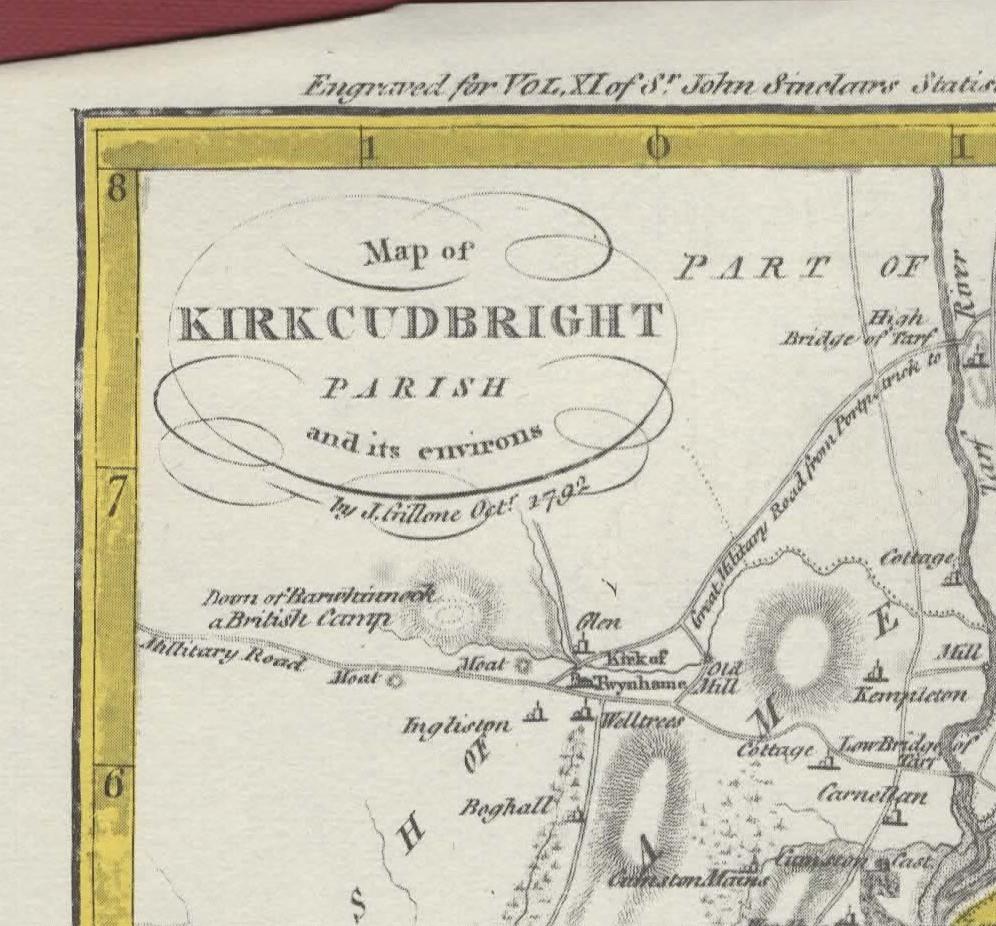
Morning Alan
Thank you very much for notes on the Ingleston names gathered by Rachel.
Walltrees caught my immediate attention as I have copies of early/mid 19th century documents relating to the property when the McCourtie / McCourty family were owners. Please find attached a scan of a section of John Gillone’s plan of Kirkcudbright parish (1792) prepared for the 1st Statistical Account. As you can see, fortunately for us he strayed across the border to include Twynholm and Walltrees. The map shows how Walltrees stands at the head of a burn which runs southwards, so a derivation of the p-n to include wælle or wella with the meaning ‘spring’ would seem to be appropriate geographically here. But your suggestion of a Celtic origin for the name is very interesting, and perhaps it may be historically significant that the site lies on the same watershed ridge (with the eastward flowing Kirk Burn to the north) as the church and motte.
best wishes
David
KeymasterFrom Michael Ansell – 27 Jun 2020…
Good afternoon Alan, very interesting. One thought would Minniebois not be the same as Monybuie near Corsock with English plural, ie probably monadh + buidhe?
Kind Regards
Michael
KeymasterFrom Alan James – 19 Jun 2020
It’s an interesting idea Mike. I don’t know much about bleaching greens, but I gather they were normally close to settlements – villages, big houses, farms etc. – in sunny, well-sheltered sites. The location of that lonely pair of fields on Moor Hill and Moss Nae (on the summit of the high ridge between the Tarff and Fleet catchments, always the windiest stretch on the A75 between Gatehouse and CD and the first to catch snow), is about as unlikely a spot for one as could be found in our area! 😊
KeymasterFrom Michael Ansell…
Good evening Alan, many thanks for this, interesting as ever. just one thought on Tower. There is a farm just outside Dalry called Tower, earlier Towy on Blaeu (mis-spelling?) and a Knocktower near Parton.
Might not these be from An Todhar/Cnoc Todhair, the bleaching green/bleaching green knoll?
Gilbert is evidently puzzled by the Tower names and considers G tùr in respect of Knocktower but in none of these examples is anything resembling a tower to be seen. Topographical imaginings of towers masquerading as inconspicuous knolls don’t really work.
So I’d say a bleaching green is a possibility for a farm field-name.
Kind Regards
Michael
-
This reply was modified 6 years, 2 months ago by
John Shields.
-
This reply was modified 6 years, 2 months ago by
-
AuthorPosts